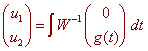
Variation of Parameters
In the last section we solved nonhomogeneous differential equations using the method of undetermined coefficients. This method fails to find a solution when the functions g(t) does not generate a UC-Set. For example if g(t) is sec(t), t -1, ln t, etc, we must use another approach. The approach that we will use is similar to reduction of order. Our method will be called variation of parameters.
Consider the differential equation
L(y) = y'' + p(t)y' + q(t)y = g(t)
And let y1 and y2 be solutions to the corresponding homogeneous differential equation
L(y) = 0
We write the particular solution is of the form
yp = u1y1 + u2y2
where u1 and u2 are both functions of t. Notice that this is always possible, by setting
u1 = 1/y1 and u2 = (yp - 1)/y2
Actually more can be said, since we are choosing two parameters to find one solution, we can impose one additional condition on the u1 and u2 and still end up with a solution. We make the assumption that
u1' y1 + u2' y2 = 0
This assumption will come in handy later.
Next take the derivative
yp' = u1'y1 + u1y1' + u2'y2 + u2y2'
The assumption helps us simplify yp' as
yp' = u1y1' + u2y2'
Now take a second derivative
yp'' = u1'y1' + u1y1'' + u2'y2' + u2y2''
Now substitute into the original differential equation to get
(u1'y1' + u1y1'' + u2'y2' + u2y2'') + p(t)(u1y1' + u2y2' ) + q(t)(u1y1 + u2y2) = g(t)
Combine terms with common u's, we get
u1(y1'' + p(t)y1' + q(t)y1) + u2(y2'' + p(t)y2' + q(t)y2) + u1'y1' + u2'y2' = g(t)
Now notice that since y1 and y2 are solutions to the differential equation, both expressions in the parentheses are zero. We have
u1'y1' + u2'y2' = g(t)
This equation along with the assumption give a system of two equations and two unknowns
u1' y1 + u2' y2 = 0
u1'y1' + u2'y2' = g(t)
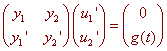
Using matrices we get
We recognize the first matrix as the matrix for the Wronskian. Calling this W, and recalling that the Wronskian of two linearly independent solutions is never zero we can take W-1 of both sides to get
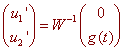
Integrate to find u1 and u2.
|
|
Example
Given that
y1 = x2 and y2 = x2 ln x
are solutions to
x2y'' - 3xy' + 4y = x2ln x
to the corresponding homogeneous differential equation, find the general solution to the nonhomogeneous differential equation.
Solution
First, we divide by x2 to get the differential equation in standard form
y'' - 3/x y' + 4/x2 y = ln x
We let
yp = u1y1 + u2y2
The Wronskian matrix is
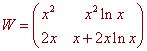
We use the adjoint formula to find the inverse matrix. First the Wronskian is the determinant which is
W = x3 + 2x3 ln x - 2x3 ln x = x3
So the inverse is
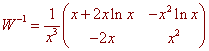
We have
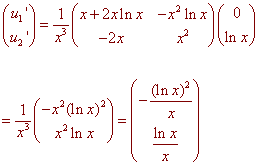
Integrating using u-substitution gives
-(ln x)3
u1
=
3
(ln x)2
u2
=
2
We have
yp = -1/3 x2(ln
x)3 + 1/2 x2 (ln x)3 = 1/6 x2(ln x)3
Finally we get
y =
c1 x2 + c2 x2 ln x + 1/6 x2 (ln x)3
Back to the Linear Second Order Differential Equations Home Page
Back to the Differential Equations Home Page
Back to the Math Department Home Page
e-mail Questions and Suggestions