The government’s crisis:
Mass Lay-off events
California vs. Florida

Marianne Bartley
Lake Tahoe Community College
Marianne Bartley
Elementary Statistics
Abstract
Mass layoff events within the United States greatly impact our economic growth and stability. I thought it would be interesting to take a look at the governmental mass layoff events for both California and Florida. Since I will be considering a move to Florida, I would like to compare their governmental stability to that of California. In this instance, I wanted to operationally define governmental stability, or rather its degree of instability, as the number of mass layoff events with government organizations. I believe that the number of mass layoff events with government organizations in California over the past three years will positively correlate with the corresponding data from Florida. If U1 stands for the mean of California’s governmental mass layoff events starting January 2000 through the present and U2 represents the mean of the Florida’s governmental mass layoff events for the same period of time, I believe that this data will show that U1-U2>0. I also think that R-sq will show a high coefficient of correlation. I hope that the P-value is less than alpha at .05.
Governmental Mass Layoff Events in California
|
|||||||||||||
|
Year |
Jan |
Feb |
Mar |
Apr |
May |
Jun |
Jul |
Aug |
Sep |
Oct |
Nov |
Dec |
|
|
2000 |
17 |
8 |
12 |
10 |
22 |
61 |
32 |
9 |
18 |
9 |
11 |
39 |
|
|
2001 |
13 |
9 |
19 |
12 |
16 |
78 |
33 |
12 |
16 |
18 |
17 |
28 |
|
|
2002 |
20 |
9 |
22 |
17 |
31 |
100 |
48 |
16 |
23 |
17 |
22 |
43 |
|
|
2003 |
24 |
18 |
23 |
22 |
50 |
153 |
79 |
23 |
31 |
33 |
22 |
38 |
|
|
2004 |
36 |
17 |
15 |
27 |
|
|
|
|
|
|
|
|
|
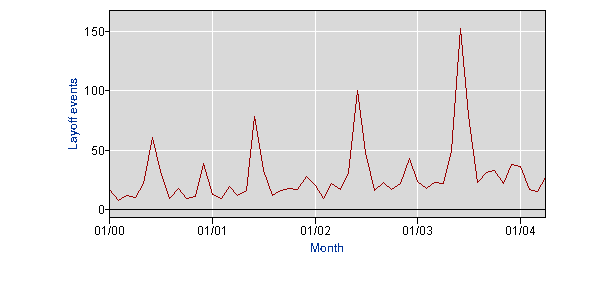
This index plot illustrates the government layoff data for California from January 2000 through April 2004. The numbers indicated in the data table represent the number of mass layoff events for the federal, state, and local sectors within the state of California. The index plot shows the number of mass layoff events peaking in June of the previous three years, presenting a pattern that I will predict will continue to repeat itself in statistical findings for June of 2004. I also think the data for this June, once collected will be greater than 153 mass layoff events, the value for the previous year.
Governmental Mass Layoff Events in Florida
|
|||||||||||||
|
Year |
Jan |
Feb |
Mar |
Apr |
May |
Jun |
Jul |
Aug |
Sep |
Oct |
Nov |
Dec |
|
|
2000 |
2 |
0 |
0 |
3 |
0 |
11 |
7 |
1 |
0 |
2 |
2 |
0 |
|
|
2001 |
0 |
3 |
2 |
2 |
1 |
17 |
1 |
3 |
0 |
3 |
1 |
1 |
|
|
2002 |
1 |
3 |
3 |
3 |
5 |
18 |
2 |
6 |
1 |
1 |
1 |
4 |
|
|
2003 |
0 |
1 |
2 |
0 |
6 |
20 |
3 |
5 |
4 |
3 |
2 |
3 |
|
|
2004 |
2 |
2 |
1 |
3 |
|
|
|
|
|
|
|
|
|
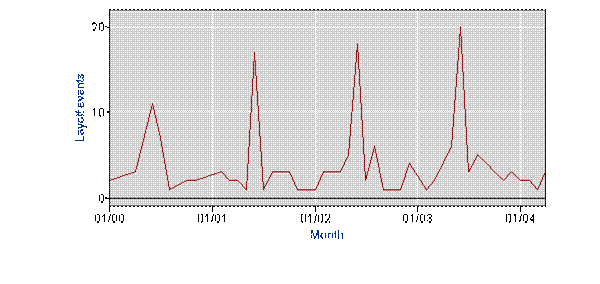
The index plot and data table for Florida contain data that is significantly different from California’s data. First of all, several months from 2000 to 2004 have had no mass layoff events. The index plot is similar to that of California because, every year, the peak layoff month remains June. The obvious difference is that all of the data represented is on a much small scale than California. This leads me to believe that Florida’s government is more stable in at least some aspects of administration.
Summary statistics
|
Column |
n |
Mean |
Variance |
Std. Dev. |
Std. Err. |
Median |
Range |
Min |
Max |
Q1 |
Q3 |
|
California |
52 |
28.807692 |
663.0603 |
25.749958 |
3.5708766 |
22 |
145 |
8 |
153 |
16 |
32.5 |
|
Florida |
52 |
3.2115386 |
18.640648 |
4.3174815 |
0.598727 |
2 |
20 |
0 |
20 |
1 |
3 |
These summary
statistics give detailed information for the states separately. Both states
have 52 data entries.
On average, there are 28 mass layoff events in California per month. The standard deviation for this sample mean is 26 with a 4% margin of error. The median value of all California data which ranges within 145 is 22 layoffs per month. 8 layoffs is the lowest number California has seen in any given month, and 153 layoffs is the largest amount it has had per month.
For the state of Florida, there are a mean of 3 mass layoff events per month with a standard deviation of 4 and a margin of error of only .6%. The median amount of layoffs per month is 2 while the sample data ranges 20 layoffs. Florida has had several instances where they have had no governmental mass layoff events and as many as 20 mass layoffs in one month.
This is a 95% Confidence Interval for paired data.
95% Confidence interval results:
mD
- mean of the difference between California and Florida
|
Difference |
Sample Diff. |
Std. Err. |
DF |
L. Lim |
U. Lim |
|
California - Florida |
25.596153 |
3.092742 |
51 |
19.387215 |
31.805092 |
With this data, we know with 95% confidence that the average monthly layoff for the two states is between 19 and 31 governmental mass layoff events per month.
This is a hypothesis test for the California average monthly layoff minus the Florida average monthly layoff.
Paired T-test results:
mD
– mean of the differences between California and Florida
H0:mD
= 0
HA:mD
> 0
|
Difference |
Sample Diff. |
Std. Err. |
DF |
T-Stat |
P-value |
|
California – Florida |
25.596153 |
3.092742 |
51 |
8.276201 |
<0.0001 |
As was evident from the initial data, the California monthly mean minus the Florida monthly mean is greater than 0, with t(8.28). We have very strong evidence of this as our P-value of .0001 is much less than alpha .05.
Boxplot

This box plot
illustrates the information given for the individual states in the summary
statistics section.
Stem and Leaf
Variable: California
0 : 89999 The stem and leaf diagram provides,
1 : 012223 at a glance, the individual
1 : 5666777778889 details data in that bar charts
2 : 0222223334 and histograms fail to show.
2 : 78
3 : 11233
3 : 689
4 : 3
4 : 8
5 : 0
High: 61, 78, 79, 100, 153
Variable: Florida
0 : 000000000
1 : 00000000000
2 : 0000000000
3 : 00000000000
4 : 00
5 : 00
6 : 00
High: 7, 11, 17, 18, 20
Scatter Plot
Dependent Variable: Florida
Independent Variable: California
Sample size: 52
Correlation coefficient: 0.829
Estimate of sigma: 2.438858
|
Parameter |
Estimate |
Std. Err. |
DF |
T-Stat |
P-Value |
|
Intercept |
-0.7924588 |
0.5102511 |
50 |
-1.5530759 |
0.1267 |
|
California |
0.13899055 |
0.013262485 |
50 |
10.479979 |
<0.0001 |

These are my simple linear regression results. The y-intercept is -.79 because Florida is the y variable and has values much smaller than California. There is a positive correlation, which I expected, because the number of governmental mass layoffs has increased over the past three years. The R-sq value is .7 and shows a moderately strong positive correlation.
Bar Plots


These bar plots are somewhat like the index plots showed at the beginning of the report, but they are more specific in data representation. Both graphs are skewed right, illustrating that the majority of monthly mass layoff data lies within the lower half of each states’ total range.
 This pie chart breaks the governmental mass layoffs for
California over the past three years into three sub-divisions; Federal, State,
and Local.
This pie chart breaks the governmental mass layoffs for
California over the past three years into three sub-divisions; Federal, State,
and Local.
Slice 1 = Federal layoffs
Slice 2 = State layoffs
Slice 3 = Local layoffs
There were 50 federal layoffs over the past three years making up 4% of the total governmental mass layoff data. 221 state layoffs make 16% of the total numbers. The largest portion of the pie chart belongs to the state level with 1132 mass layoff events and 80% of the total data since January of 2000.
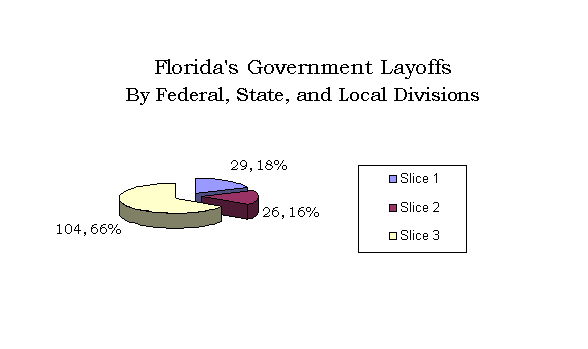 This pie
chart breaks the governmental mass layoffs for Florida over the past three years
into three sub-divisions; Federal, State, and Local.
This pie
chart breaks the governmental mass layoffs for Florida over the past three years
into three sub-divisions; Federal, State, and Local.
Slice 1 = Federal layoffs
Slice 2 = State layoffs
Slice 3 = Local layoffs
There were 29 federal mass layoff events over the past three years making up 18% of the total governmental mass layoff data. California’s federal layoff percentage was the lowest of its statistics with only 4% of the total layoffs. 26 state layoffs make 16% of the total numbers, which happens to be the same percentage of state mass layoff events as California. The largest portion of the pie chart belongs to the state level with 104 mass layoff events and 66% of the total data since January of 2000. That is 14% less than California’s 80% state layoff data.
Conclusion
The majority of organizations whether private or government-run have been negatively impacted by recent events in our country. Our economy has greatly suffered and everyone is feeling the pinch. Three years ago, my mother was laid off from her job with the state of California because of budget cut backs. After only a year of working for our local school district, she, along with a number of other teachers and secretaries, had to be let go because of budget cuts on the local level. This project has given me information about the government that I had not suspected before. Although I cannot determine causation from any of the statistical data that I have found, I would suspect that administrative difficulties with the California government might have something to do with its drastically higher mass layoff event numbers. I know that Florida’s recent voting drama may have given them a less than remarkable image, “hanging chads” and all, but Florida’s governmental administrators seemed to have done something right. The government workers on the federal, state, and local levels in Florida all have higher job security based than those workers in California based upon the data collecting through previous years.