Applications, Radicals, and Hidden Quadratics
-
Applications
Some pointers on solving word problems.
-
Read the question and ask yourself what the problem is asking.
-
Label variables: Write "Let x = ..." where x should be a numerical variable that will give the solution. Then label any other variables if needed
-
If possible draw the picture.
Recall the Pythagorean Theorem:
a2 + b2 = c2
where a and b are the lengths of the legs of the right triangle and c is the length of the hypoteneuse.
-
Reread the problem phrase by phrase, inserting the variables when they are spoken in the phrase. (Recall that is ,will be, was, are, equate to =.)
-
Using the phrases come up with appropriate equations.
-
Solve the equations.
-
Reread the problem and answer it making sure that the answer makes sense.
Example 1:
One number is three times another. The sum of their reciprocals is 20/3. Find the numbers.
-
Read the question.
-
Let x = one number, y = another number
-
Not applicable
-
x is three times y. The sum of 1/x and 1/y is 20/3.
-
x = 3y 1/x + 1/y = 20/3
1/(3y) + 1/y = 20/3
Multiply by 3y: 1 + 3 = 20y
y = 1/5 so x = 3/5
The first number is 3/5 and the other number is 1/5.
Example 2:
Chris is 4 years older than Gina. In 6 years the sum of their ages will be 68. what are their ages now?
-
Let x = Chris' age y = Gina's age
-
NA
-
x is four more than y. The sum of six more than x and six more than y will be 68. what are x and y?
-
x = 4 + y (x + 6) + (y + 6) = 68
[(4 + y) + 6] + (y + 6) = 68
2y + 16 = 68 2y = 52
y = 26
x = 4 + y = 30
Chris is 30 years old and Gina is 26 years old
Exercises
-
The product of two numbers is 85. What are the numbers if one number is 2 more than three times the other?
-
One Leg of a right triangle is 20 feet and the hypoteneuse is 30 feet. Find the length of the other leg.
-
Avery throws a football straight up in the air. The equation
-16t2 + 90t
gives the distance s in feet that the football is above the ground t seconds after he throws it.
How high is the ball after 2 seconds? after 30 seconds?
How long does it take for the ball to hit the ground?
-
-
Radical Equations
If we have an equation with a single radical then we follow the procedure:
-
Isolate the radical so that the radical is alone on the left side of the equation with everything else on the other side of the equation.
-
Square both sides of the equation
-
Bring everything back to the left side of the equation so that the right side is a 0.
-
Solve the resulting equation by factoring, the root method, the quadratic equation, of some other method.
-
Plug your answer back into the original equation making sure that your result is an actual solution and not an extraneous one.
Example:

-

-
7x + 4 = (x + 2)2
7x + 4 = x2 + 4x + 4
-
x2 - 3x = 0
-
(x)(x - 3) = 0
x = 0 or x = 3
-
 ok
ok
Exercise
Solve

Equations with two radicals:
If an equation has two radicals, we follow the following procedure:
-
Put the two radicals on the left hand side and everything else on the right hand side.
-
Square both sides (be careful to FOIL the two radicals)
-
This will result in an equation with one radical. Now follow the procedures for one radical.
Example:
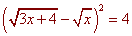
Solve

-

-

-

-

-
(3x + 4)(x) = 4x2
3x2 + 4x = 4x2
x2 - 4x = 0
(x)(x - 4) = 0
x = 0 or x = 4
-
Check:
 - 2 - 0 = 0 ok
 - 2 -
= 0 ok
- 2 -
= 0 ok
-
-
Hidden Quadratics:
Often we encounter an equation that is a quadratic in disguise. For example the equation
x4 + 3x2 - 4 = 0
is a fourth degree equation. Notice that the exponent of the leading term is twice the exponent of the second term. Because of this we can use what is called a substitution:
Let
u = x2
then
x4 = u2
Then the equation in terms of u becomes:
u2 + 3u - 4 = 0
which is a quadratic. Hence, we can factor:
(u - 1)(u + 4) = 0
So that
u = 1 or u = -4
Since u = x2 we have that
x2 = 1 or x2 = -4
The first has solution
x = 1 or x = -1
and the second has no solution.
Exercise
x2/3 - x1/3 - 6 = 0
Hint let u = x1/3
Back to the Factoring Home Page
Back to the Intermediate Algebra (Math 154) Home Page
Back to the Math Department Home Page
Questions, Comments and Suggestions: Email: greenl@ltcc.edu