Alternating Series
I. Quiz
II. Homework
III. The Alternating Series Test
Suppose that a weight from a spring is released. Let a1 be the distance that the spring drops on the first bounce. Let a2 be the amount the weight travels up the first time. Let a3 be the amount the weight travels on the way down for the second trip. Let a4 be the amount that the weight travels on the way up for the second trip, etc.
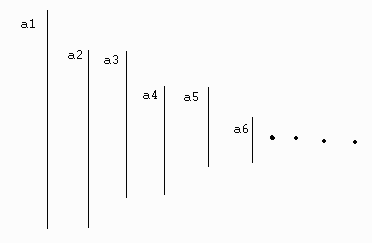
Then eventually the weight will come to rest somewhere in the middle. This leads us to
Theorem: The Alternating Series Test
Let an > 0 for n and suppose that the following two conditions hold:
1) { an } is a decreasing sequence for large n.
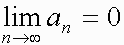
2) 
Then the corresponding series sum (-1)nan converges.
Proof:
We have
s2n = (a1 - a2) + (a3 - a4) + ...+ (a2n-1 - a2n) > 0
and
s2n = a1 - (a2 - a3) - (a4 - a5) - ...- (a2n-2 - a2n-1) - a2n
So s2n < a1
Hence s2n is bounded and monotonic and hence converges. Since s2n+1 -> s2n the limit of the partial sums exist and hence the series converges.
IV. Examples
sum of (-1)n /n converges since the limit of 1/n is 0 and 1/n > 1/(n + 1)
Exercises:
Determine whether the following converge:
A) Sum (-1)n + 1/n!
B) Sum (-1)n n2/(n + 1)
V. The Remainder Theorem
Consider the spring example again. The weight will always be between the two previous positions. Hence we have
The Remainder Theorem
Let L = sum (-1)nan then
|L - sn| < an + 1
Example: Use a calculator to determine
sum (-1)n+1/n
With an error of less than .01
Solution:
We have Error < .01 so choose n such that a/n < .01 (n = 101)
Then use your calculator.
VI. Absolute and Conditional Convergence
Definitions:
1) sum(-1)nan is called absolutely convergent if sum an converges
2) sum (-1)nan is called conditionally convergent if sum(-1)nan converges, but sum an diverges.
For example the alternating harmonic series is conditionally convergent sum (-1)n+1/n
while the series sum (-1)n+1/n2 is absolutely convergent.
VII. The Rearrangement Theorem: Let sum (-1)n+1an be a conditionally convergent series and let k be a real number. Then there exists a rearrangement of the terms so that you add them up and end up with k. As strange as it may seem, addition is not commutative for conditionally convergent series. On the other hand for absolutely convergent series any rearrangement produces the same limit.