I. Quiz
II. Homework
III. Limits Using Tables
Consider the function f(x) =

Notice that this function is undefined at x = -1. In calculus undefined is not as precise as possible. Instead one asks, what does the y value "look like" when the x value is near -1. The table below demonstrates:
| x | -0.9 | -1.1 | -0.99 | -1.01 | -0.999 | -1.001 |
| y | -1.9 | -2.1 | -1.99 | -2.01 | -1.999 | -2.001 |
We see that if x is close to -1, then f(x) is close to -2. We say "the limit of f(x) as x approaches -1 is -2" and write
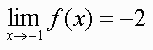
If the y value does not tend toward a single number as x tends towards a, then we say that the limit does not exist as x approaches a.
Exercises: Use a table to find the following limits if they exist.

IV. Limits and Graphs
Looking at the graph of a function is another convenient way of determining a limit. For example, a computer was used to graph the the function
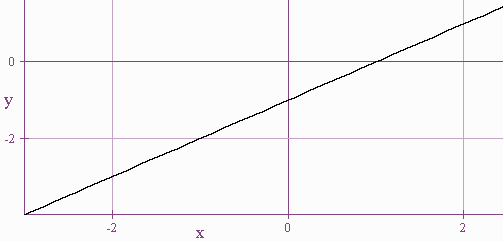
Notice that the computer indicates that the y value approaches -2 as the x value approaches -1. In fact, the computer ignores the fact that the function is undefined at x = -1.
Exercise: Use a graphing calculator to find the limits from the prior exercise if they exist.
V. The Epsilon-Delta Game
Choose a function and a number. Let partner A select a y range. Partner B must find an x range so that the graph leaves the box on the sides and not the top and bottom. If Partner B can always win, then the function has a limit at that number. We will play this game first with me as Partner B and the class as Partner A. Then the class will pair up and do it themselves.