Infinite Geometric Series
I. Homework
II. Definition of an Infinite Geometric Series
We learned that a geometric series has the form

We call the series

the infinite geometric series.
III. Calculating the Infinite Geometric Series
I will do the classic example of walking half way to the wall then walking half way and so on. This demonstrates that
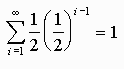
We say that this series converges to 1.
Suppose that r = 2 and a1 = 1
then the infinite geometric series is
2 + 4 + 8 + 16 + ...
We see that these numbers just keep increasing to infinity.
In general, if |r| > 1 then the geometric series is never defined. We say that the series diverges.
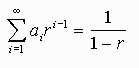
If |r| < 1 then recall that the finite geometric series has the formula
sum from i = 1 to n of a1ri-1 = a1[(1 - rn)/(1 - r)]
If n is large then rn will converge asymptotically to 0 and hence we have the formula
Example:
Find sum from i = 1 to n of 2(1/3)i-1
Solution:
We have 2/(1 - 1/3) = 2/(2/3) = 3
IV. Repeating Decimals
Recall that a rational number in decimal form is defined as a number such that the digits repeat. We can use a geometric series to find the fraction that corresponds to a repeating decimal.
Example:
.737373737... = .73 + .0073 + .000073 + ...
we have a1 = .73 and r = .01 Hence
.73737373.... = .73/(1 - .01) = (73/100)/(99/100) = 73/99
V. Interval Of Convergence
If an infinite series involves a variable x, then we call the interval of convergence the set of all x such that the interval converges for that x. For example
sum from i = 1 to infinity of xi-1 has interval of convergence -1<x<1.
Example: find the interval of convergence of
sum from i = 1 to infinity of (3x - 2)i-1
We write |3x - 2| < 1 we solve
3x - 2 =1 or 3x - 2 = -1
x = 1 or x = 1/3
Hence 1/3 < x < 1 is the interval of convergence.